
What Comes First: Knowledge or Context?
We can start with a rule and find the context needed to apply it. Or a customer’s situation can reveal which knowledge is missing. Either way, we think giving AI access to context deserves as much attention as improving its knowledge. Together, they guide what it should say and do.
The same question can have two correct answers
Imagine two customers asking to change a delivery address. One is told yes, the other no. In this example, the company allows changes until the warehouse starts packing. The first order is still waiting. The second is already being packed.
The answers look inconsistent without the order status. That detail explains why each customer received a different response.
The AI needs access to the order system to check the current packing status. It can then work out whether the change is allowed and, if it has permission to update orders, make it.
Context-specific knowledge explains when an answer or action applies. The agent needs the details of the customer’s situation to know when to use it.
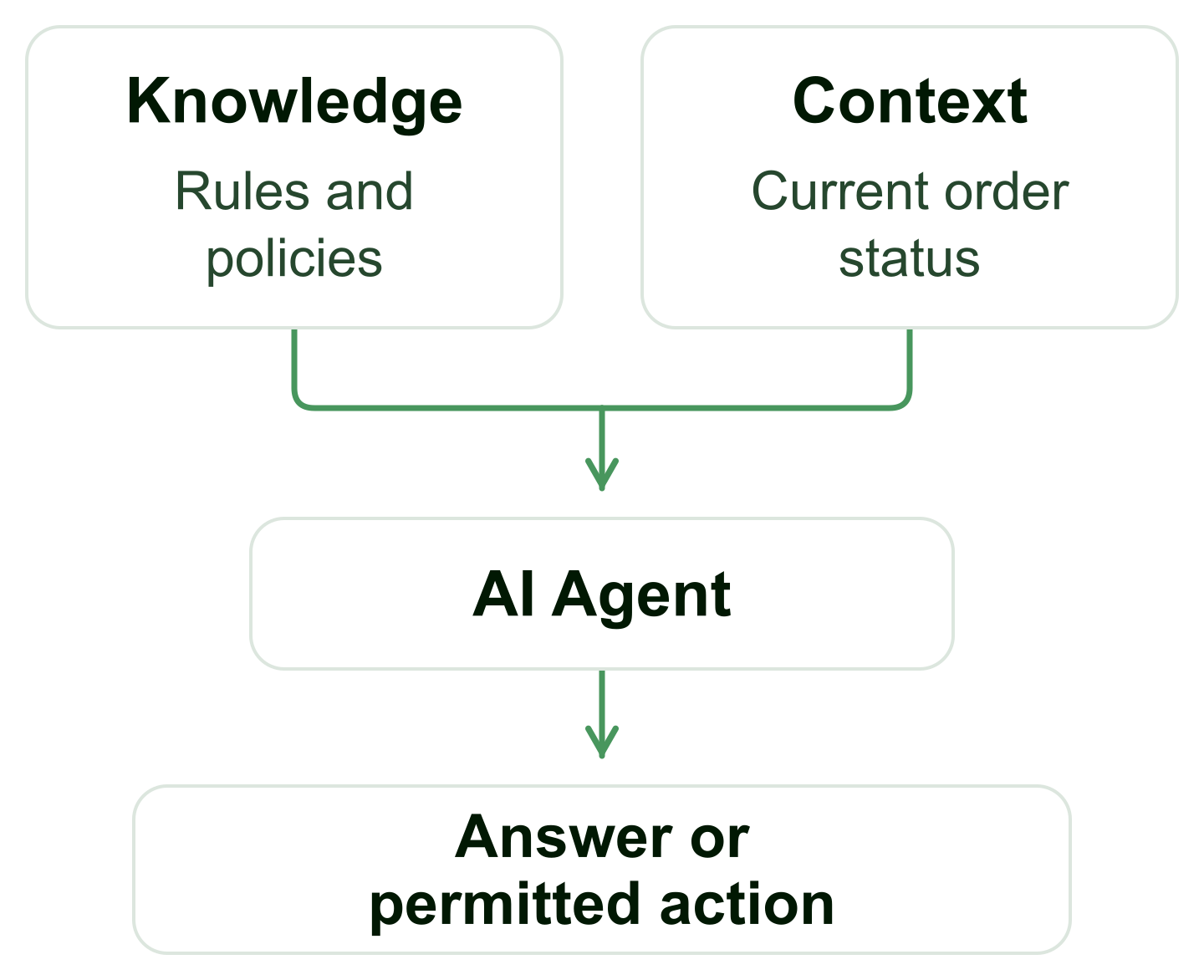
The Consortium for Service Innovation’s KCS® guidance makes a similar point: keep the details that explain why similar requests need different solutions. Capturing those details alongside the conversation helps the team understand what happened and what the AI could learn from it.
Learning from how an answer was reached
An experienced service agent might check an order, recognise an unusual situation or ask a colleague for approval before replying. A transcript may contain the final answer without those steps.
Those steps can show what the AI was missing. An approval rule may need to be added to its knowledge. An order status it could not see may mean giving it access to more context.
AI can help compare similar conversations and point out differences. The team may need to ask the person who handled a case to understand the decision. They can then check whether the agent needs better knowledge, access to missing context, or both.
When there is still no clear answer
The same distinction matters when a case remains unresolved.
If the AI knows the rule but cannot see the order status, the missing piece is context. If it has the status but nobody has decided whether an exception is allowed, the team needs to clarify the rule before adding it to the knowledge.
KCS makes room for work-in-progress knowledge. Teams can share what they know while an answer is still being worked out. In an AI workflow, that record could also show which context was unavailable, so the next step is clearer.
Making sure it works in practice
Start with a few conversations about the same request. Check which rules the AI had and whether it could access the context needed to apply them. That helps you decide whether to improve the knowledge, provide more context, or both.
Then try the change in a few different situations: an order before packing, one after packing and one where the status cannot be checked. The AI should give the right answer, only make changes it is allowed to make and ask for help when it cannot check the facts.
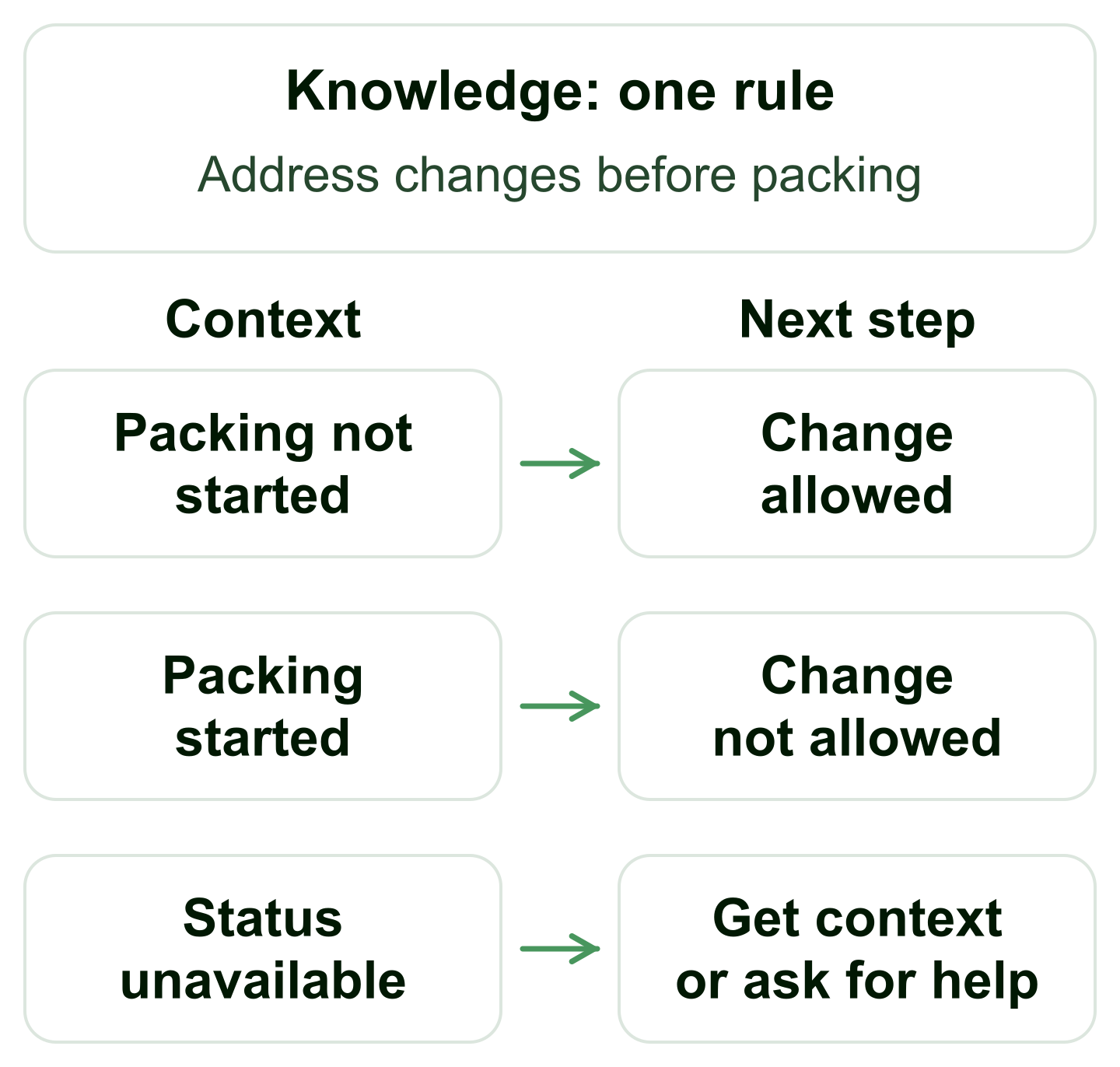
We think this is an important part of Human-on-the-Loop. People improve both what the AI knows and the context it can access, then check how those changes affect its answers and actions.
This thinking is shaping what we’re building next at Ebbot. We’ll share more as the work takes shape.
KCS® is a service mark of the Consortium for Service Innovation™.
More stories


How Anglia Ruskin University is evolving its service experience with Ebbot & TOPdesk
Facing rising enquiry volumes from nearly 48,000 students, Anglia Ruskin University set out to modernise its support experience. By combining an AI agent from Ebbot with TOPdesk, the university has expanded self-service, increased out-of-hours availability, and reduced pressure on the support team.
.jpg)
.jpg)

“Lundvig has become a natural part of the team”
Lunds Kommuns Fastighets AB (LKF) has a clear goal: it should be easy for residents to get in touch and receive help. But in recent years, the pressure on the customer center has increased. This raised a clear challenge: “How do we improve accessibility without increasing staffing?"
.jpg)
Building trustworthy AI Agents in the EU AI Act era
As adoption of AI grows, so does the need for safety, transparency, and compliance with new regulations like the EU AI Act. To understand what that looks like in practice, we caught up with Felicia Ekener from our AI team, for a closer look at the process behind creating reliable AI Agents.

AI Chatbots vs AI Agents - What's the difference?
If you’ve been keeping an eye on the AI space (especially in customer service) you might have noticed a shift in wording from AI chatbot → AI Agent. So what’s going on? Is AI Agent just a cooler name, or is there an actual difference in what it is? Let’s break it down.
.jpg)
Product deep dive: AI Insights
If your customer service team is using an AI chatbot, you’re already sitting on a goldmine of data. Every chat conversation is filled with insights. But when you’ve got thousands of conversations happening every month, spotting the real patterns can feel impossible. Enter: Ebbot AI Insights ✨

.png)
.png)
Ebbot expands in telecom – welcomes Bredband2 as a new customer
Ebbot is strengthening its presence in the broadband and telecom sector, where the demand for AI-driven customer service solutions is growing rapidly. The latest addition to Ebbot’s client portfolio is Bredband2, one of Sweden’s largest fiber-optic internet providers.
.png)
Ebbot becomes AI partner to Europcar Sweden – launches chatbot Estrid
Ebbot has been entrusted with developing and implementing Europcar Sweden’s new AI-powered chatbot: Estrid. The chatbot is designed to provide faster, smarter, and more personalized service to Europcar’s customers – around the clock.